
Download Product Catalogues



 (1).webp)
 (1) (1).webp)
 (1) (3).webp)
Choosing a power transmission component starts with the right information. On this page you can download product catalogue PDFs from Supreme Engineers, an Ahmedabad-based manufacturer of timing pulleys, timing belts, universal joints, gears and sprockets, rack and pinion sets, couplings and keyless clampex. Use the catalogues to compare types and sizes, then contact our team with your requirement and we will help you finalise the specification. Choose the catalogue you want, then open or save the PDF, and if you have any trouble with a download, contact our team and we will help.
What the product catalogues cover
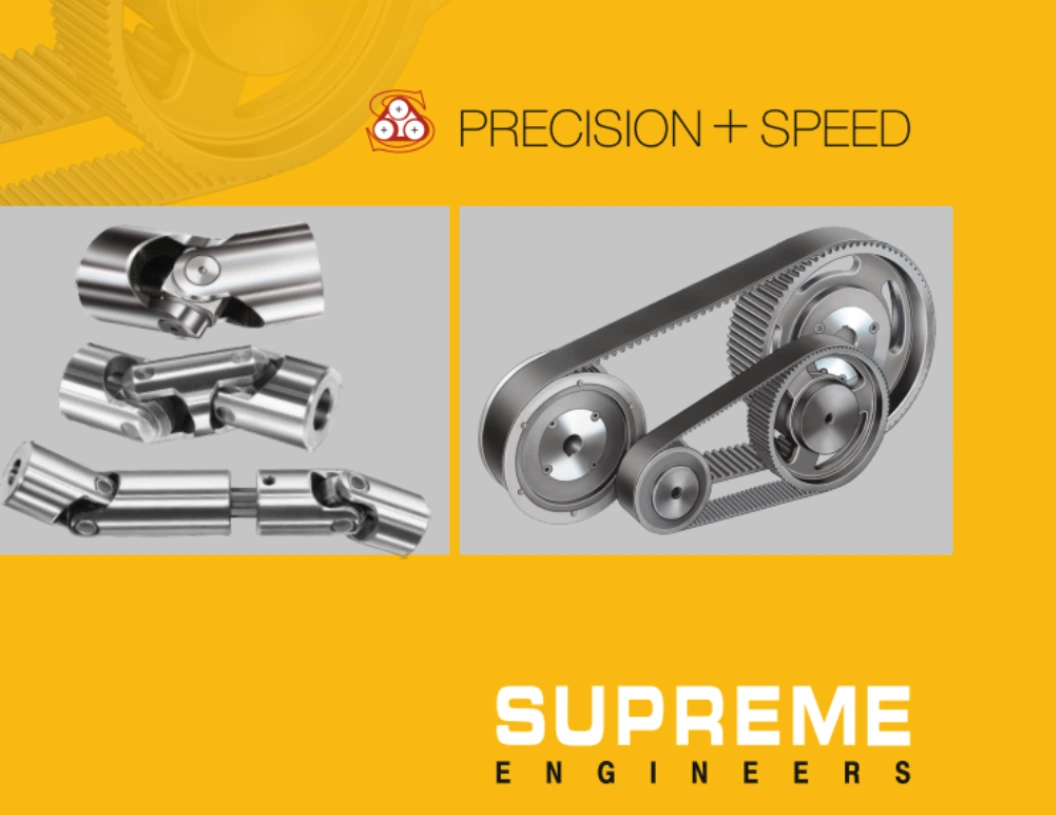
The catalogues on this page cover our power transmission ranges, including timing pulleys, universal joints, gears, rack and pinion, keyless clampex and couplings. Use them to identify the product family, compare the available types and understand the specifications you need to confirm before ordering.
A catalogue is a starting point, not the final word. Standard parts suit many machines, but your shaft size, space, load or speed may call for a variation, and that is where our custom manufacturing helps. If a catalogue item is close but not exact, tell us what needs to change and we will review it.
Download product catalogue PDFs by product family
Start with the product that matches your problem. For synchronised drives, look at timing pulleys and timing belts. For connecting shafts at an angle, look at universal joints. For speed reduction or linear motion, look at gears, sprockets and rack and pinion. For joining shafts end to end, look at couplings, and remember that a flexible coupling absorbs small misalignment while a universal joint connects shafts that meet at an angle. For fixing hubs to shafts without keyways, look at keyless clampex. If you are unsure, describe your machine in an enquiry and our team will point you to the right range. Download the matching catalogue and compare sizes before you enquire.
How to read a pulley, gear or joint specification
Every component is described by a few key dimensions and ratings, and knowing them makes any catalogue easy to use. For timing pulleys the key details are tooth profile, pitch, number of teeth, bore and width. The tooth profile and pitch must match the belt exactly, for example MXL, XL, L, H, HTD or GT2, and if the belt is unmarked you can measure the pitch and count the teeth, or send us a sample so we can help identify it. The number of teeth, together with motor speed, sets the speed ratio, and the bore and hub must fit the shaft.
For gears and racks, the module defines tooth size and must match the mating part, while pressure angle and face width affect strength and smooth running. For universal joints, bore and length decide the fit, while the working angle and the torque decide how long the joint lasts. For keyless clampex and couplings, the shaft diameter and hub bore define the size, and the torque to be carried defines the model. With couplings, also note the shaft diameter at both ends and how much misalignment must be absorbed.
Comparing materials and finishes
Size is only part of a specification. When you compare parts, also look at the material and any surface treatment, because these decide how a component copes with load, wear, moisture and heat. Aluminium suits lighter pulleys where low inertia and weight matter, while steel suits higher loads, harder wear and shock. If your machine runs in a damp, dusty or washdown environment, mention it in your enquiry so that our team can suggest a suitable material and finish.
Information to have ready before you request a quote
Have the component type, the key dimensions, the material if you have a preference, the quantity, and a short description of where it will be used. A drawing or the existing part helps most. The more detail you provide, the faster our team can confirm the specification and quote.
Useful details include shaft diameter and tolerance, bore and keyway size, operating speed and torque, the environment such as dust, heat or moisture, and any surface treatment you need. If the part replaces a worn one, measure it carefully or send it to us, and photos of the part from two or three angles can also help our team identify it quickly. For repeat orders, mention your expected annual quantity so that we can plan.
Parts that are not in the catalogue
If the part you need is not in the catalogue, contact us with a drawing, sample or description. Supreme Engineers manufactures a variety of custom-made products, and our CNC turning, VMC and gear-cutting equipment lets us machine non-standard pulleys, shafts, gears and couplings to your requirement. Our team will confirm feasibility and quote.
Many buyers begin by downloading a catalogue and then ask for a modified version of a standard part, such as a different bore, a longer hub or a special tooth count. Our custom components page explains how that process works.
Using the catalogue to replace a worn part
Measure the old part before you search. Record the bore, outer diameter, width and tooth count, and note the belt or mating part it works with. Compare these figures with the catalogue and, if nothing matches exactly, send us the part or a sketch so that we can reproduce it.
Take care with pulleys: measure the pitch of the belt, count the teeth, and check the profile rather than assuming it from the size. With gears, count the teeth and measure the outside diameter to find the module. With universal joints, note the bore, length and fixing method. If the original is badly worn, send the mating part as well.
Download the catalogue, note the products that fit, and then send us your requirement with quantity and application details. Our team in Ahmedabad will review it and respond with a quote. For non-standard needs, share a drawing or sample so that we can discuss a custom solution.